Understanding JavaScript's Call Stack: The Backbone of Execution
JavaScript is a powerful programming language that manages execution in a structured way using the call stack. If you've ever wondered how JavaScript knows which function is currently running or where the execution should return after completing a function, the answer lies in the call stack.
What is the Call Stack?
The call stack is a fundamental part of the JavaScript engine, responsible for keeping track of function execution. It ensures that JavaScript executes functions in the correct order and knows where to return once a function has completed. Think of the call stack as a stack of books: the book (function) you are currently reading is always on top, and when you finish it, you remove it and go back to the previous book.
How the Call Stack Works
1. Adding Functions to the Call Stack
When JavaScript encounters a function call, it adds that function to the call stack. This ensures that JavaScript knows it is currently executing that function. For example, if we call a function multiplyByTwo(3), JavaScript pushes this function onto the call stack:
multiplyByTwo(3) // Added to the call stack
At this moment, JavaScript is inside multiplyByTwo and is not executing any other function.
2. Executing and Returning from Functions
Inside a function, JavaScript processes each line of code. If a function completes its execution, it gets removed (popped) from the call stack, and execution returns to the function or scope that called it. The keyword return signals JavaScript that a function has finished executing.
For instance:
function multiplyByTwo(num) {
    return num * 2;
}

let result = multiplyByTwo(3);
- The function
multiplyByTwo(3)is added to the call stack. - JavaScript executes the function.
- When it reaches
return num * 2;, the function is popped off the stack. - Execution returns to the global scope where
resultis assigned the returned value.
3. Returning to Global Execution
When all functions finish executing, the call stack returns to the global execution context. The global context is always at the bottom of the call stack and represents the main JavaScript program.
4. Handling Nested Function Calls
If a function calls another function inside it, JavaScript adds the new function to the top of the stack. When the inner function completes, JavaScript removes it from the stack and resumes execution of the outer function. This behavior follows a Last In, First Out (LIFO) structure.
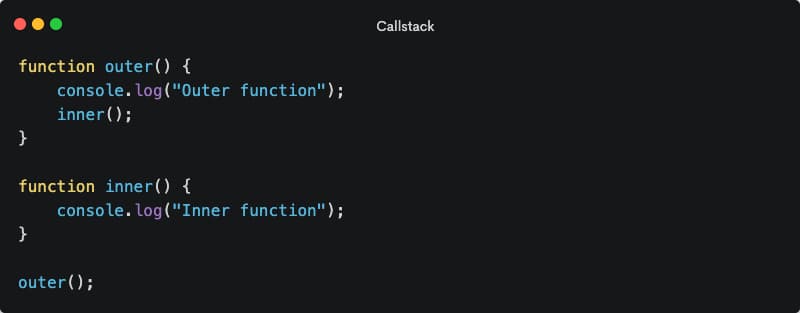
Consider this example:
function outer() {
    console.log("Outer function");
    inner();
}

function inner() {
    console.log("Inner function");
}

outer();
outer()is added to the call stack.- Inside
outer(),inner()is called and added on top of the stack. - JavaScript executes
inner()and removes it after completion. - Execution returns to
outer(), which then finishes and is removed from the stack. - The call stack returns to the global execution context.
Why the Call Stack Matters
Understanding the call stack helps in debugging errors like stack overflow, which happens when too many functions are pushed onto the stack without being removed. This can occur in infinite recursion:
function recursiveFunction() {
    recursiveFunction();
}

recursiveFunction(); // Stack Overflow Error!
JavaScript will keep adding recursiveFunction to the stack indefinitely, causing it to exceed its limit and crash.
Conclusion
The call stack is a critical concept in JavaScript, helping manage function execution in an organized manner. By understanding how it works, you can write better, more efficient code and debug issues more effectively. Whether you’re dealing with function calls, nested functions, or recursion, the call stack is always at work behind the scenes, ensuring your code runs smoothly.