Why Do We Use Functions?
At their core, functions help us avoid redundancy and write cleaner, maintainable code. Instead of repeating the same logic multiple times, we encapsulate it in a function and reuse it whenever needed. Let’s take a simple example:
function tenSquared() {
    return 10 * 10;
}

console.log(tenSquared()); // 100
This function does one thing: it returns the square of 10. But what if we wanted to calculate the square of different numbers?
Avoiding Repetition: The DRY Principle
Writing separate functions for nineSquared(), eightSquared(), and so on would be inefficient and violate a key programming principle: DRY (Don't Repeat Yourself). Instead, we generalize our function by introducing parameters:
function squared(num) {
    return num * num;
}

console.log(squared(10)); // 100
console.log(squared(9));  // 81
console.log(squared(8));  // 64
Now, our function is reusable, handling multiple cases without rewriting the same logic.
What Are Higher-Order Functions?
While parameters allow us to reuse functions with different data, what if we could also make our functions more flexible by modifying their behavior? This is where higher-order functions come in.
A higher-order function is a function that either:
- Takes another function as an argument, or
- Returns a function.
This makes our functions even more reusable and dynamic. Consider a simple example:
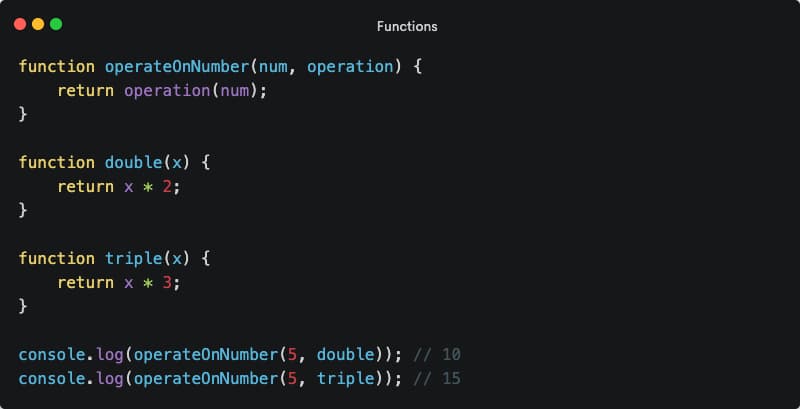
function operateOnNumber(num, operation) {
    return operation(num);
}

function double(x) {
    return x * 2;
}

function triple(x) {
    return x * 3;
}

console.log(operateOnNumber(5, double)); // 10
console.log(operateOnNumber(5, triple)); // 15
Here, operateOnNumber is a higher-order function because it takes a function (operation) as an argument and applies it to num. This makes it extremely flexible, allowing different behaviors depending on the function passed in.
The Power of Higher-Order Functions
Higher-order functions are the backbone of many JavaScript features, including array methods like map, filter, and reduce. For example:
const numbers = [1, 2, 3, 4, 5];
const squaredNumbers = numbers.map(num => num * num);
console.log(squaredNumbers); // [1, 4, 9, 16, 25]
The map method takes a function as an argument and applies it to each element of the array, returning a new transformed array.
Conclusion
Functions in JavaScript provide a foundation for clean, efficient, and reusable code. By using parameters, we can generalize functionality, and by leveraging higher-order functions, we can make our code even more dynamic and powerful. Understanding and applying these concepts will help you write more scalable and maintainable JavaScript programs.