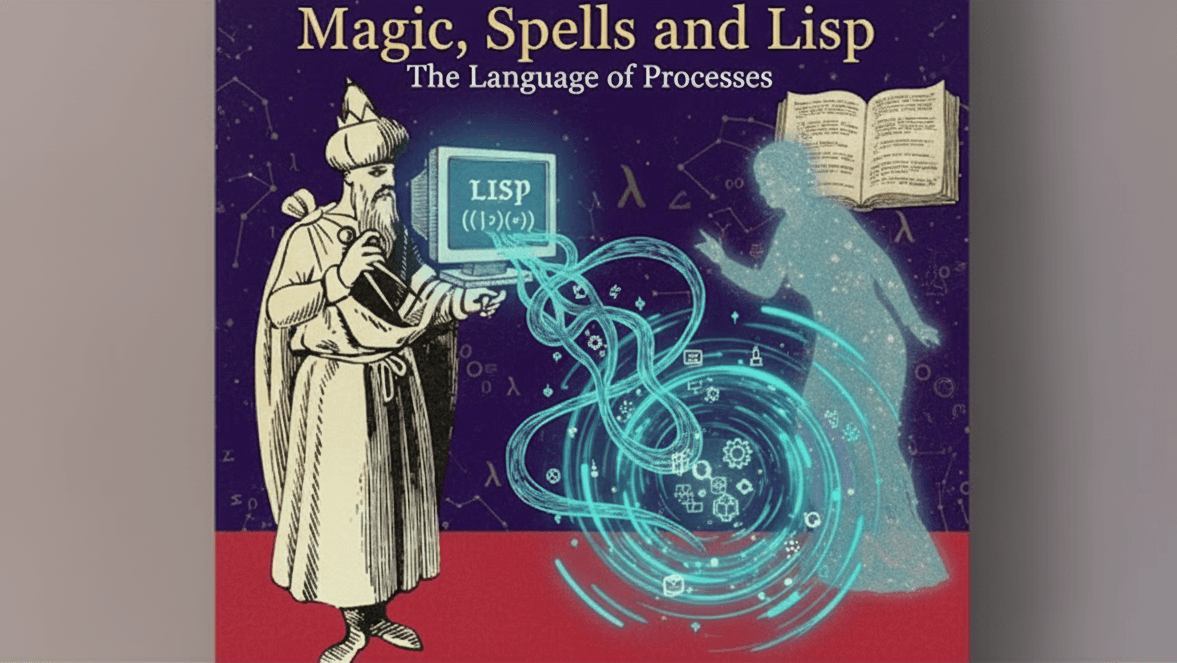
The Magic Behind Computation
When you run a program, something invisible comes to life.
Lines of text transform into motion, computation, and logic.
That something is what we call a process a kind of “magical spirit” that lives inside the computer and carries out our instructions.
But every spirit needs a spell to summon it.
In computer science, those spells are procedures the precise sets of rules that direct a process to act.
“Procedures are the spells that control these magical spirits called processes.”
This is more than metaphor. It captures the very essence of programming: describing how to do something in such exact terms that even a machine "a mindless mechanism" can perform it flawlessly.
Spells, Rules, and the Art of Control
Every procedure is a recipe for conjuring a process.
When you define a function, you’re writing a spell: a compact incantation that creates and controls behavior.
Just as ancient magicians needed the right language to summon their powers, programmers need a language with the right expressive structure to shape computation.
That’s where Lisp enters the story.
Why Lisp? The Perfect Magical Language
Lisp was created in the late 1950s by John McCarthy as a mathematical way to talk about computation itself.
It wasn’t designed for convenience or speed—it was designed for clarity of thought.
Lisp treats procedures as first-class citizens: things you can create, pass around, and even return from other procedures.
It’s a language for talking about how-to knowledge, not just using it.
In the MIT course, the professor described Lisp as the “magical language” of computer sorcery.
Real sorcerers, he joked, might chant in Sumerian or Babylonian; we, instead, conjure with parentheses.
That playfulness hides a deep truth: Lisp was the first language to let humans reason about processes as data—to treat the act of doing as something you could study, transform, and build upon.
Learning the Rules vs. Mastering the Implications
Learning Lisp is easy—at least at first. You can understand the rules in minutes.
The syntax is simple, elegant, and consistent.
But understanding Lisp deeply—the implications of those rules—can take a lifetime.
It’s the difference between memorizing the rules of chess and becoming a chess master.
You can learn the rules quickly, but mastery comes from understanding patterns of strategy, not individual moves.
Likewise, programming mastery comes from understanding how simple rules combine to create complexity—how small, elegant ideas build entire systems.
Key Takeaway
Programming is an act of controlled magic.
We use precise symbols to direct invisible forces—the processes that make modern computation possible.
And Lisp, with its clarity, purity, and recursive elegance, is the perfect spellbook.
Next in the Series:
Post 3 – Controlling Complexity: The True Challenge of Computer Science
We’ll explore why complexity—not computation—is the real problem computer scientists face, and how abstraction helps us keep chaos under control.