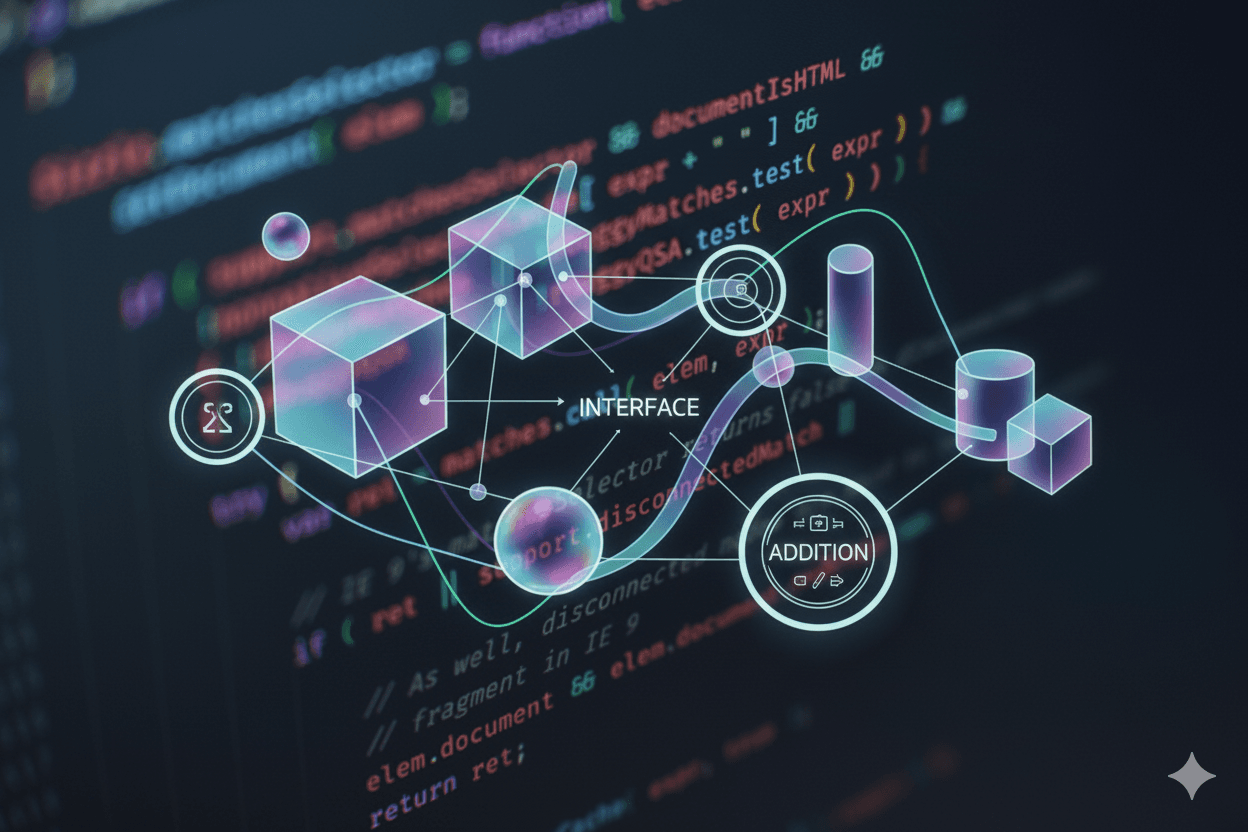
Why Interfaces Matter
Every abstraction, no matter how cleanly designed, must eventually interact with others. A black box is useful only when it can connect to other boxes without breaking.
This is where interfaces come in—the shared contracts that define how different components communicate, without revealing how they’re implemented.
Think of an interface as a language treaty: two tribes can trade ideas without speaking the same native tongue.
If one side updates its inner workings but maintains the same “vocabulary,” the other side never notices the change.
“A system without stable interfaces is a system without trust.”
In computer science, interfaces are not just about function signatures—they’re about convention. They define the shape of communication, the expectations, and the rhythm of interaction.
The Power of Generic Operations
Now imagine you have several types of data: numbers, vectors, polynomials, and signals.
They seem unrelated—until you realize that all of them support an operation called addition.
- For numbers: 3 + 4 = 7
- For vectors: (2, 3) + (4, 1) = (6, 4)
- For polynomials: (x² + 3x) + (2x² + 1) = 3x² + 3x + 1
- For signals: adding two waveforms combines them into one.
This is the concept of a generic operation—a single abstract action that adapts depending on the types of objects it touches.
Generic operations make systems both extensible and elegant.
You can add a new type, like a matrix, without rewriting the entire language of arithmetic.
You just define what “addition” means for that new type, and the rest of the system continues to understand you.
This kind of flexibility underlies the design of most programming paradigms, from functional polymorphism to object-oriented inheritance.
Interfaces as Conventions, Not Constraints
A common misunderstanding is that interfaces restrict freedom. In truth, they do the opposite—they enable it.
When two modules share a clear interface, each can evolve independently.
A data pipeline, for instance, might transform a user record into an analytic summary. As long as the input and output shapes stay consistent, the inner logic can change entirely.
This is why software architecture is so much about convention over configuration.
We rely on stable agreements between parts of a system, allowing innovation to occur inside the boxes while stability persists between them.
Two Metaphors for Thinking About Systems
1. The Society of Objects – Object-Oriented Metaphor
In the Object-Oriented worldview, a program is a society of objects.
Each object is an individual: it has its own data (state) and knows how to perform certain actions (methods).
Objects collaborate by sending messages to one another.
This metaphor emphasizes encapsulation and responsibility.
Each object manages its own behavior and hides its data behind methods.
A well-designed system becomes a kind of organized society—each citizen playing a role, obeying certain laws (interfaces), and contributing to the greater good.
For example:
car.accelerate()
user.send_message("Hello World!")
You don’t care how the car accelerates or how the user sends a message—you trust the interface.
2. The Stream of Signals – Functional / Dataflow Metaphor
In contrast, functional programming often uses a signal-processing metaphor.
Instead of objects that act, we have streams that flow.
Each function transforms data from one form to another, like filters in a signal chain.
Think of a sound studio: microphones capture signals, filters refine them, and speakers output sound.
Each stage is a pure transformation—no side effects, no stateful memory—just data flowing through a pipeline.
const processed = input .filter(removeNoise) .map(applyGain) .reduce(mixChannels);
This way of thinking highlights composition and transformation rather than identity and responsibility.
Instead of citizens, we have waves; instead of actions, we have flows.
The Harmony Between the Two
The beauty of modern software is that these metaphors coexist.
A well-architected system might treat user interactions as objects but internal data as streams.
For instance, a chat application could model users and messages through OOP, while processing those messages through reactive data streams.
Both paradigms depend on generic operations and consistent interfaces—the unifying grammar of software.
No matter how data moves or who acts upon it, shared conventions ensure that everything stays compatible.
“A good interface is like a handshake between worlds.”
Why This Matters Beyond Code
Interfaces and conventions aren’t just technical tools; they mirror how humans collaborate.
Languages, APIs, and protocols are extensions of the same social instinct: to agree on meaning, so that complexity can scale.
Just as human civilization depends on shared languages and customs, large-scale software depends on agreed abstractions.
Without them, communication breaks down, and the system collapses into noise.
Key Takeaway
Interfaces are the social contracts of computation.
They allow diverse components—each with its own behavior and design—to collaborate harmoniously.
Generic operations give these interfaces life, enabling shared behavior across different kinds of entities.
Whether through the society of objects or the stream of signals, abstraction and convention together create the stability that makes evolution possible.
Next in the Series:
Post 6 – Metalinguistic Abstraction: Making New Languages
In the next post, we’ll explore how computer scientists go beyond using languages—they create them. We’ll see how designing new languages allows us to model new worlds of thought and control complexity at an entirely new level.